Game creation
Soulstack Studio
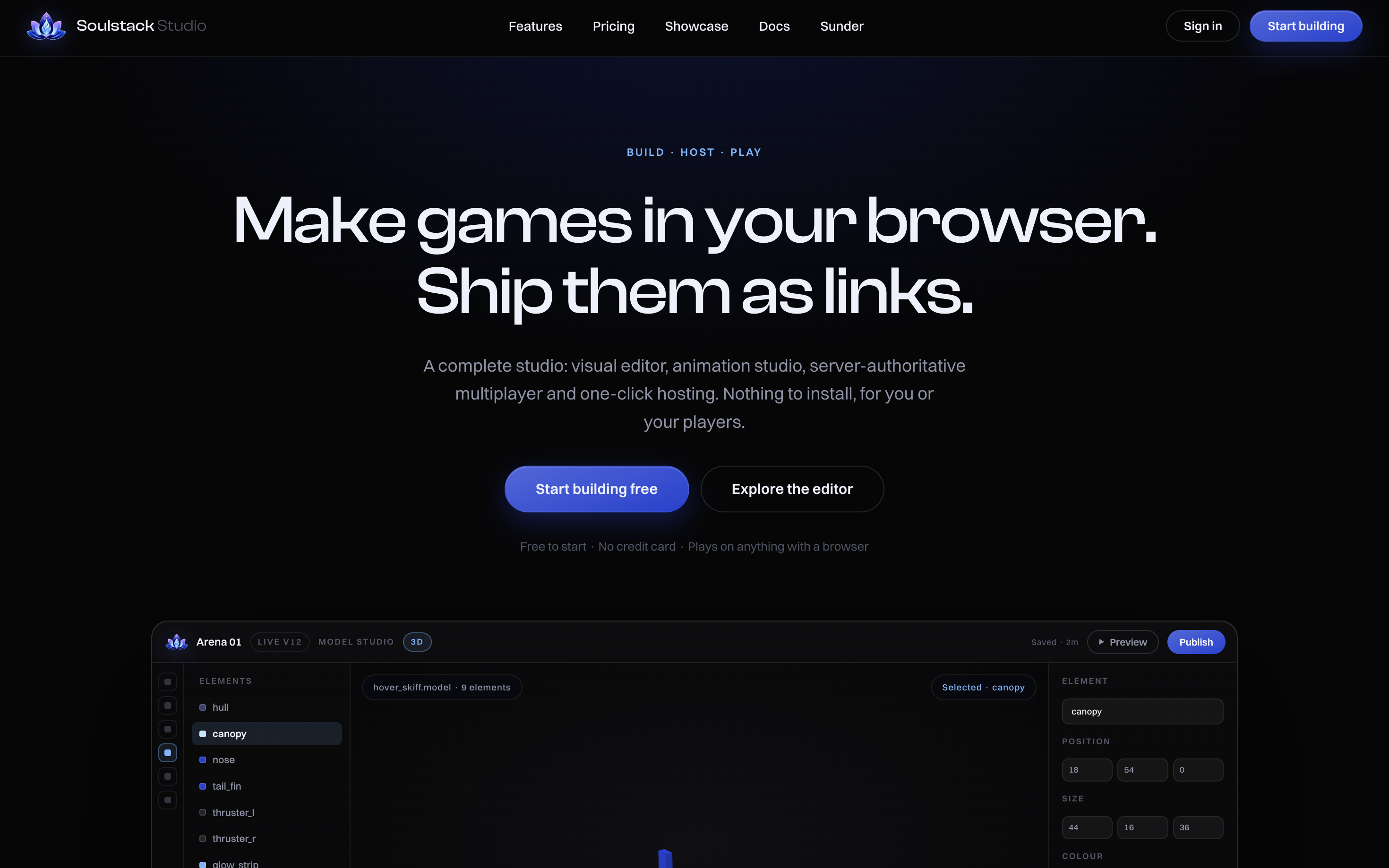
Status: In developmentMake games in your browser, then ship them as links.
A complete browser-based game studio: a visual editor, an animation studio, and one-click hosting, with server-authoritative multiplayer proven by Sunder, our own game built on it. Nothing to install, for you or your players.

Soulstack Studio
Game creation
The platform
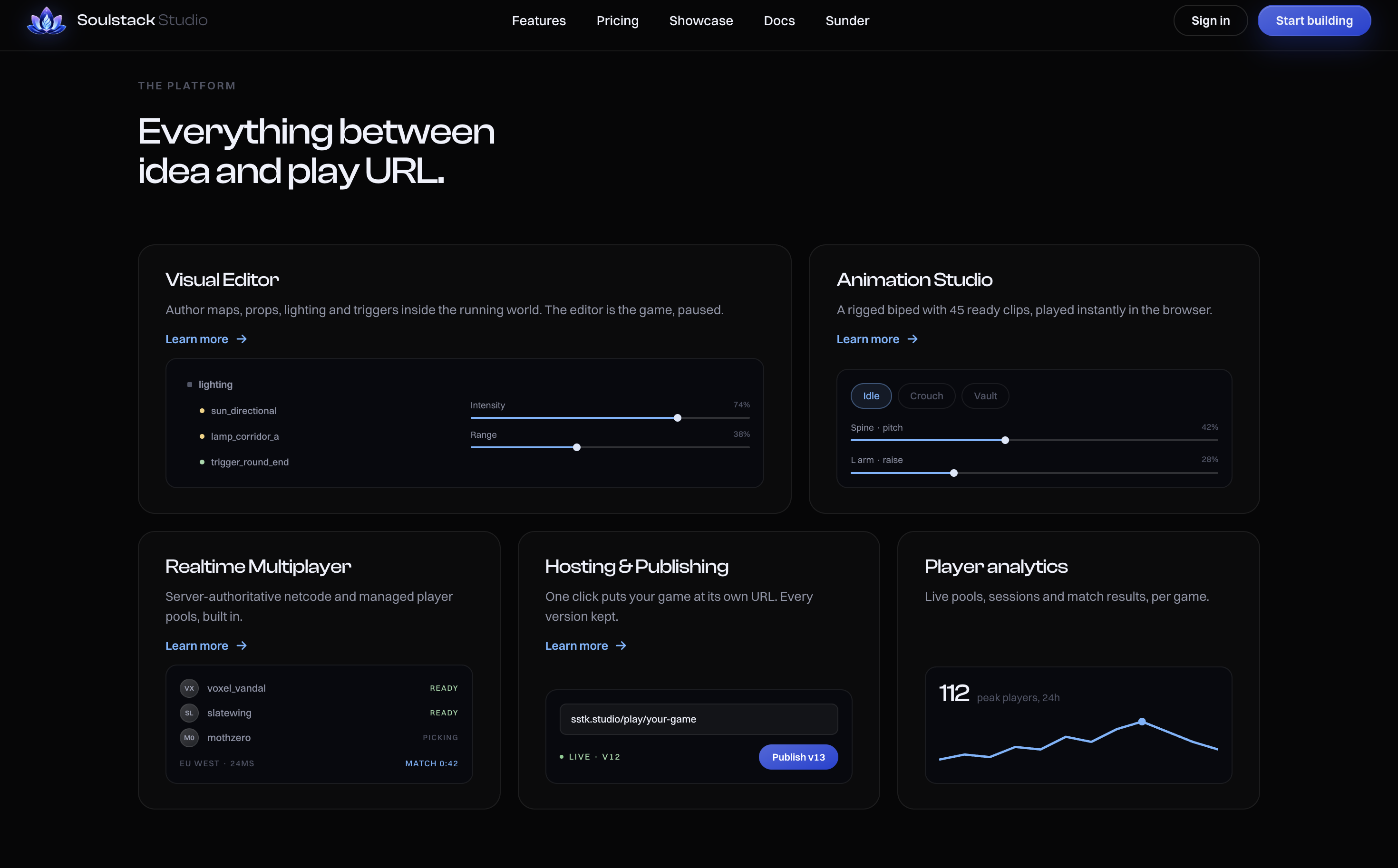
Everything between idea and play URL
Four pillars carry every game, from the first placed prop to the published URL. The editor is the game, paused: you build, pose and play-test in the same running world, then publish from the same place. Multiplayer is proven too, by Sunder, our own game running server-authoritative on the same engine.
- Author whole worlds in the scene, with no rebuilds
- Pose a rigged character with 45 ready-made clips
- Every project gets its own wiki, with search and revision history
- Publish to a live, versioned URL in one click
- Visual editor
- Animation studio
- Project wikis
- Hosting and publishing
How it works
From a blank project to a playable link
Start blank in 2D or 3D and the whole studio adapts. Edit the world, pose characters and upload assets, then hit play and walk it yourself. One more click puts the game live at its own sstk.studio address.
- Start blank in 2D or 3D, all in the browser
- Play-test in place before you publish
- Every published version kept, restore instant
- Create a project
- Build and play-test
- Publish to a URL
Made on the platform
Sunder, built on Soulstack Studio
Sunder is our own browser tactical shooter, built on Soulstack Studio and running server-authoritative multiplayer built specifically for it on the same engine. Precise gunplay decides fights, hand-cast abilities called Casts shape the space, and round-based Rift Core objectives decide the match, with two sides, Incursors and Wardens, attacking and defending. It is in active development.
- A competitive, round-based shooter that runs in the browser
- Attack and defend as Incursors and Wardens over Rift Core sites
- Proof that the engine can carry real, server-authoritative multiplayer
- Browser tactical shooter
- Precise gunplay
- Hand-cast Casts
- Rift Core rounds
The platform
One stack, the whole game
A complete toolchain for making and shipping a browser game, with nothing to install for you or your players.
- 01
Visual editor
Place props, sculpt lighting and wire triggers in the running world. No mode switches, no rebuilds.
- 02
Animation studio
A rigged biped ships with every project, with 45 ready-made clips you can play back instantly.
- 03
Multiplayer, proven by Sunder
Server-authoritative multiplayer with prediction and reconciliation, proven in production by Sunder. A shared multiplayer package for every project is planned, not yet built.
- 04
Project wikis
Every project gets its own wiki, with full-text search, revision history, and public hosting alongside the game.
- 05
Hosting and publishing
Publishing snapshots your project and puts it live at its own sstk.studio address, with versioned restores.
- 06
Runs in the browser
Nothing to install, for you or your players. It plays on anything with a browser.
- 07
In development
Studio is in active development. Public sign-ups are opening soon, and it stays free to start.
Made on the platform
Games built on Soulstack Studio
Real games, each with its own page. Four are live and playable now; Furrow is still in development and links back to the Studio itself.
Sunder
Status: LiveA server-authoritative tactical shooter built on Soulstack Studio, where guns win fights and hand-cast abilities shape the fight around them.Nine Lives
Status: LiveA precision platformer where every death unlocks a new way to move, as a black cat escaping a cursed city.Furrow
Status: In developmentA cosy co-op farm for one to four players, starring cats who walk upright to work and drop to all fours to run.The Dwindling
Status: LiveA first-person horror game about holding the torch on him for as long as you can bear it.Mewsli
Status: LiveA cat cafe match-3 puzzle game about treats, chapters, and a growing roster of cafe cats.
A closer look
Soulstack Studio in action
Make a game in your browser
Soulstack Studio is in active development. Explore the platform now, with public sign-ups opening soon.